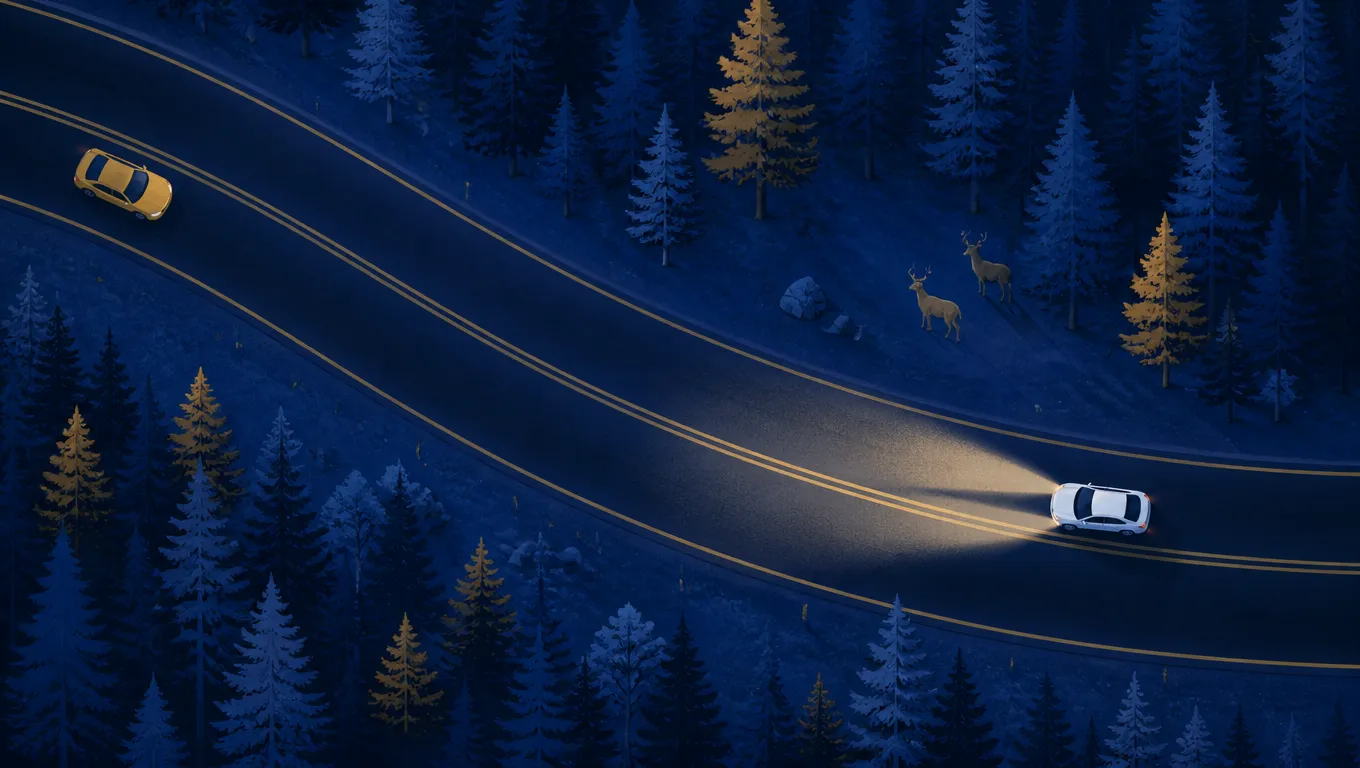
Wildunfall was tun? After a collision with a wild animal (Wildunfall) you stop, switch on the hazard lights, put on the warning vest and set up the warning triangle. Then you call the police on 110, or 112 if a person is hurt. You do not touch the animal and you do not take it with you.
Wildunfall was tun: the steps in order
- Hazard lights on. Stop as far to the right as you can.
- Warning vest on before you get out.
- Set up the warning triangle. The distances are in warning triangle and breakdown steps.
- Anyone injured: call 112 and give first aid.
- Call the police on 110 and say exactly where you are. The ADAC advises this in every case, also when nobody is hurt and also when the animal has run off injured.
- Wait at a safe place, behind the barrier if there is one, until the police or the hunter arrive.
- Ask for a written confirmation of the wildlife accident (Wildunfallbescheinigung). The police or the hunter responsible for the area issue it.
- Take photos of the place, the car and, if it is there, the animal.
In many federal states the local hunter must be told as well. The police can pass the report on, which is one more reason to call them.
Why you leave the animal alone
An injured deer or boar is frightened and strong. It can kick or bite. Keep your distance.
A dead animal can carry parasites or disease, so it should not be touched with bare hands. If it lies on the road and is a danger to the next driver, the ADAC advice is to pull it to the verge with gloves, when you can do that safely.
Do not put the animal in your boot. Wild animals belong to nobody, and the right to take them lies with the hunter. Driving away with one can be treated as poaching (Wilderei).
Brake, do not swerve
The rule for the moment before the collision is part of the theory you learn for the exam. If an animal is on the road:
- brake,
- dip the main beam, because bright light makes animals freeze,
- sound the horn,
- stay in your lane.
If the collision cannot be avoided, hold the wheel firmly and brake hard in a straight line. Do not swerve. A swerve at country road speed can end in a tree or in oncoming traffic, and both are worse than the animal.
Some numbers show why speed matters here. With the rule of thumb for braking distance, 100 km/h gives 100 m of normal braking, and 80 km/h gives 64 m. Add the reaction distance and you stop after about 130 m at 100 km/h and after about 88 m at 80 km/h. Those 40 m are often the difference. The formula is explained in braking distance.
One animal is often followed by more. After the first deer has crossed, stay slow and watch both edges of the road.
Where and when to expect animals
Deer and wild boar cross mostly at dusk, at night and at dawn. Typical places are roads through forest and along the edges of fields. The triangular warning sign with the leaping deer (Wildwechsel) marks stretches where crossings are known.
Where the sign stands, slow down, be ready to brake and look at the verges, not only at the lane. Use the main beam with care. It helps you see far, but dip it at once when you see an animal.
According to the insurers’ association figure quoted by the ADAC, about 276,000 wildlife accidents were reported in Germany for 2024. This is not a rare event.
What the insurance needs
This part is not exam content, but it is the reason for the certificate.
- Partial cover (Teilkasko) usually pays for damage to your moving car from a collision with furred game (Haarwild) such as deer, boar, fox or hare. Some policies cover all animals. Check yours.
- Fully comprehensive cover (Vollkasko) also pays when the cause cannot be proven, but a claim can cost you your no-claims class.
- Liability insurance pays for damage you cause to other people, for example if you hit another car.
- You cannot normally claim from the hunter or the forest owner, because wild animals have no owner.
Without the certificate and photos it is hard to prove that an animal was involved, above all when it ran away. Tell your insurer without delay.
Common mistakes
- “I swerve to save the animal and my car.” Wrong. Swerving is the most dangerous choice. Brake in your own lane.
- “Full beam shows me more, so I keep it on.” Wrong. An animal blinded by full beam stays where it is. Dip the lights.
- “The animal ran away, so nothing has to be reported.” Wrong. An injured animal suffers, and you need the report for your insurer. Call the police.
- “I take the dead animal with me so the road is clear.” Wrong. Taking it can count as poaching. Move it to the verge at most, with gloves.
- “It was only one deer, the danger is over.” Wrong. Animals often move in groups. Expect the next one.
How to remember it
Before the hit: brake, dip, horn, straight on.
After the hit: lights, vest, triangle, then 110. The first three are the same as for every breakdown, so you only need to learn the phone call and the two bans: do not touch, do not take.