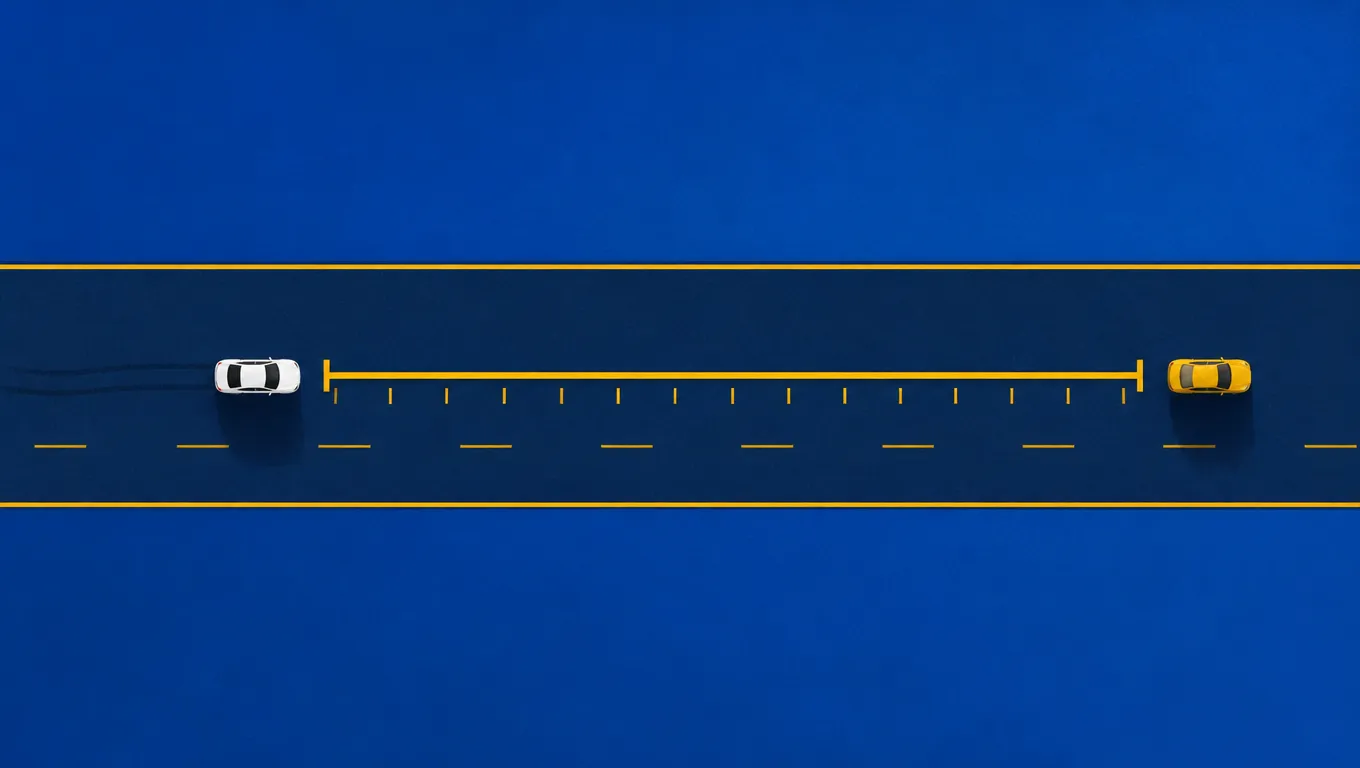
The Bremsweg Formel is a rule of thumb: braking distance in metres = (speed in km/h ÷ 10) × (speed in km/h ÷ 10). At 50 km/h that gives 5 × 5 = 25 m. For emergency braking you take half of the result, so 12.5 m.
What the braking distance is
The braking distance (Bremsweg) is the way the car travels from the moment you press the brake until it stands still. It does not include the time you need to notice the danger and move your foot. That part is the reaction distance. Both together make the stopping distance.
German driving theory uses two versions of the rule:
- Normal braking (normale Bremsung): speed ÷ 10 × speed ÷ 10
- Emergency braking (Gefahrbremsung): the same result, divided by 2
Both are rules of thumb (Faustformeln). They are not physics formulas and they are not written in any law. They describe a car in good order on a dry, level road.
The Bremsweg Formel step by step
Take 80 km/h as an example.
- Divide the speed by 10: 80 ÷ 10 = 8.
- Multiply that number by itself: 8 × 8 = 64.
- The normal braking distance is 64 m.
- For emergency braking, halve it: 32 m.
The same steps give these values:
| Speed | Normal braking | Emergency braking |
|---|---|---|
| 30 km/h | 9 m | 4.5 m |
| 50 km/h | 25 m | 12.5 m |
| 80 km/h | 64 m | 32 m |
| 100 km/h | 100 m | 50 m |
| 130 km/h | 169 m | 84.5 m |
Why double the speed means four times the distance
Look at 50 and 100 km/h in the table. The speed doubles. The braking distance goes from 25 m to 100 m, which is four times as far. This happens because the speed appears twice in the formula. The braking distance grows with the square of the speed.
Small differences in speed matter more than they seem. From 30 to 50 km/h the speed rises by two thirds, but the braking distance almost triples, from 9 m to 25 m. This is why 30 km/h instead of 50 km/h makes such a difference near schools and in residential streets.
The same square rule applies to the force that pushes the car outwards in a bend. Twice the speed means four times the force. So you brake before the bend, not in it.
What makes the real braking distance longer
The rule of thumb gives a value for good conditions. On the road the distance is often longer. The main causes are:
- A wet, snowy or icy surface. The tyres have less grip, and the distance grows a lot.
- Worn tyres. The legal minimum tread is 1.6 mm, but grip on wet roads gets worse long before that.
- Worn brakes.
- A heavy load.
- A downhill road.
Nothing in this list shows up in the formula. That is why you treat the result as the best case and keep a reserve.
What ABS does and does not do
The anti-lock braking system (ABS) stops the wheels from locking during hard braking. The car stays steerable, so you can brake and steer around an obstacle at the same time. In an emergency you press the brake pedal as hard as you can and keep it down. The pedal may pulse. That is normal, and you do not ease off.
ABS does not always shorten the braking distance. It cannot create grip that the road does not offer. The same is true of ESP and of four-wheel drive. None of them is a reason to drive closer to the car ahead. How much room you should leave is covered in the post on the safe following distance.
Common mistakes
- “Twice as fast means twice the braking distance.” No. It means four times the distance, because the speed counts twice in the formula.
- “The braking distance is how far I need to stop.” No. Before you brake, the car travels on for about one second at full speed. You must add the reaction distance to get the stopping distance.
- “Emergency braking is a different formula.” It is the same formula. You only halve the result at the end.
- “The formula gives the real distance.” It is a rule of thumb for a dry road and a sound car. Rain, ice, worn tyres, load and a slope all lengthen it.
- “My car has ABS, so I can follow more closely.” ABS keeps the car steerable. It does not beat physics and it does not shorten your reaction time.
How to remember it
“Double the speed, four times the distance.” If you remember only one sentence about braking, take this one.
For the formula itself, think of a square: drop the last zero of the speed and multiply the number by itself. 50 becomes 5, and 5 × 5 is 25. If the question says emergency braking, cut the square in half.