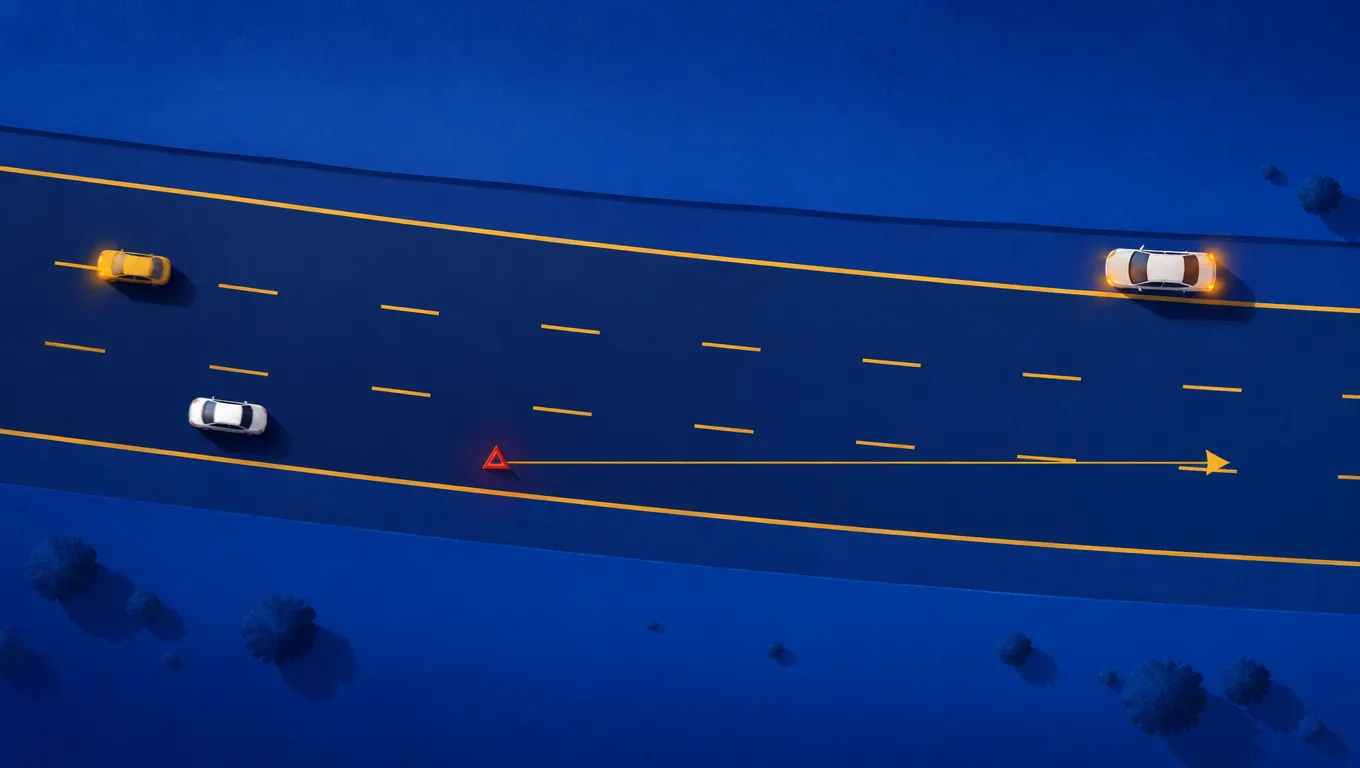
The Warndreieck Abstand taught for the theory exam is about 50 m in town, about 100 m on country roads and at least 150 m on the motorway. The warning triangle (Warndreieck) always goes before a bend or hilltop if your car stands behind one. Before the triangle come two other steps: hazard lights on, warning vest on.
Warndreieck Abstand: how far back the triangle goes
| Road | Distance to the car |
|---|---|
| In town | about 50 m |
| Country road | about 100 m |
| Motorway | at least 150 m, better 200 m or more |
Only one of these numbers is in the law. The road traffic regulations say the warning sign must stand at a sufficient distance, and at about 100 m where traffic is fast. The other values are teaching values. They follow one idea: the faster the traffic, the more time drivers need, so the further back the triangle goes.
Two ways to measure without a tape:
- One long step is roughly 1 m.
- The marker posts (Leitpfosten) at the road edge usually stand 50 m apart. Two posts are about 100 m, four posts about 200 m.
If the car stands behind a bend or a hilltop, the distance alone is not enough. Put the triangle before the bend, so drivers see it before they see your car.
Carry the opened triangle in front of your body so it already warns while you walk. Walk at the very edge of the road, or behind the barrier where there is one. Place it near the right edge of the road.
Breakdown: the order of steps
The first danger in a breakdown is the traffic behind you, not the fault in the car.
- Hazard warning lights (Warnblinkanlage) on, at once.
- Let the car roll as far to the right as possible.
- Warning vest (Warnweste) on before you get out.
- Set up the triangle.
- Wait in a safe place and call for help.
Only after that do you look for the fault. In the dark, leave the side lights on as well.
On a motorway there are extra rules. Steer onto the hard shoulder. Everyone gets out on the side away from the traffic, normally the passenger side, and waits behind the crash barrier. Nobody stays in the car. Small arrows on the marker posts point to the nearest emergency phone. A missed exit or a dead engine is never a reason to reverse or turn on a motorway.
Accident: secure, call, help, stay
If you are involved in an accident, or the first to arrive, the order is:
- Stop and get an overview.
- Secure the scene: hazard lights, vest, triangle.
- Call 112.
- Give first aid until the rescue service arrives.
The order protects you. A helper who is hit by the next car helps nobody. If several people are there, share the work: one secures, one calls, one helps.
For the call, start with the place. Then say what happened, how many people are injured and which injuries or dangers there are. Then wait for questions. The operator ends the call, not you. 112 is free and works across the European Union. The police number is 110.
Everyone must help as far as it can be expected of them. Failing to help (unterlassene Hilfeleistung) is a criminal offence. You do not need to be a doctor. The course you take for the licence covers the basics, see eye test and first aid course.
On multi-lane roads, the traffic behind an accident must open an emergency corridor as soon as it slows to walking pace.
Staying at the scene
Everyone whose behaviour may have contributed to the accident counts as involved and must stay. You say that you were involved. On request you give your name and address, show your driving licence and vehicle papers and give details of your liability insurance.
After only minor damage, move the cars to the side without delay so traffic is not blocked. Take photos first if you can do so safely.
If nobody is there, for example after you touched a parked car, wait a reasonable time. Then leave your name and address at the scene and report the accident without delay to the owner or a nearby police station. Leaving without doing this (Unfallflucht) is a criminal offence, even when the damage is small. A note under the wiper alone is not enough.
What must be in the car
A car must carry a warning triangle, a warning vest and first aid material. As of November 2026 the catalogue of fines lists 15 euro for a missing or unusable triangle and 5 euro for missing first aid material. A broken-down car that is not secured as required, with danger to others, costs 60 euro.
Keep the vest where you can reach it from the driver’s seat, not under the luggage.
Common mistakes
- “I put the triangle right behind the car.” Wrong. Drivers need time to react. Use about 50, 100 or at least 150 m, depending on the road.
- “First I check what is wrong with the engine.” Wrong. Lights, vest and triangle come first.
- “On the motorway I wait in the car with the belt on.” Wrong. Get out on the passenger side and stand behind the barrier.
- “Others have surely called 112 already.” Wrong. The duty to help applies to everyone at the scene. Call.
- “It is only a scratch, a note is enough.” Wrong. Wait, then report it to the owner or the police without delay.
How to remember it
For the distance: 50, 100, 150 and up. It rises with the speed of the road, like the speed limits themselves.
For the order: lights, vest, triangle, then phone. You make yourself visible from the inside out: first the car, then yourself, then the road behind you.