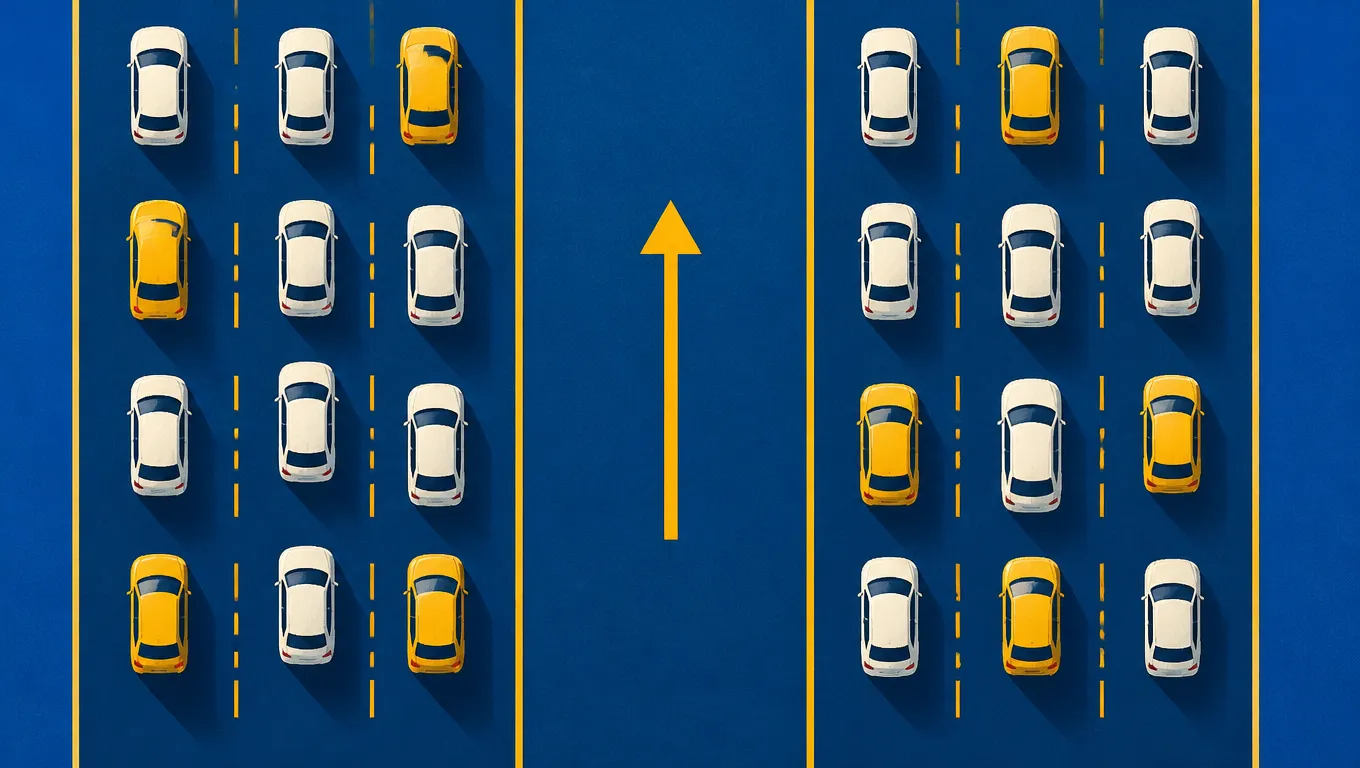
A Rettungsgasse (emergency corridor) is a free lane that drivers open in a traffic jam so that police and rescue vehicles can get through. The rule is simple. Vehicles in the far-left lane move to the left. Vehicles in all other lanes move to the right. You form it as soon as traffic slows to walking pace or stops, not when you first hear a siren.
Where the Rettungsgasse is required
The duty applies in two places:
- on motorways (Autobahnen), see Autobahn rules
- on roads outside built-up areas (Außerortsstraßen) with at least two lanes for one direction
In towns there is no fixed corridor rule. There the general duty applies: when a vehicle approaches with blue light and siren, you clear the way at once in whatever manner the place allows. See blue light and siren.
When to form it
The law names the moment: as soon as vehicles move at walking pace (Schrittgeschwindigkeit) or stand still. You do not wait for a siren, a radio message or the car in front.
The reason is space. While traffic is still rolling, every car can steer a metre to the side. Once everyone stands bumper to bumper, nobody can move, and the rescue vehicle is stuck behind you.
Two habits make it work:
- When you roll up to the end of a jam, steer to your side at once and keep a gap to the vehicle in front. With a gap you can still correct your position later.
- According to ADAC you may switch on the hazard lights briefly as you approach the end of a jam, to warn the traffic behind.
Which way each lane moves
The corridor is always between the far-left lane and the lane directly beside it. The number of lanes does not change that.
| Lanes in your direction | Far-left lane | Every other lane |
|---|---|---|
| 2 | to the left | right lane to the right |
| 3 | to the left | middle and right lane to the right |
| 4 | to the left | the three other lanes to the right |
A worked example. You are in the middle lane of a three-lane motorway and traffic slows to a crawl. You are not in the far-left lane, so you move to the right, close to the vehicles in the right-hand lane. The cars on your left move to the left edge of their lane. The corridor opens on your left.
In roadworks with narrow lanes the same rule applies. If there is truly not enough room, ADAC advises everyone to keep as far right as possible and to leave bigger gaps between vehicles, so that rescue vehicles can pass on the left.
The hard shoulder is not part of the corridor
The hard shoulder (Standstreifen) stays free. Broken-down vehicles need it. What to do if that is you is covered in breakdown and accident steps. The corridor is formed between the lanes, not on the edge of the road.
According to ADAC there are two exceptions. You may move onto the hard shoulder when the police direct you to, or when there is no other way to open a corridor at all.
Who may use the corridor
Only police vehicles and aid vehicles. That includes the fire brigade, ambulances, emergency doctors and recovery vehicles.
Everyone else stays out:
- You may not drive through the corridor yourself, however long the jam lasts.
- You may not follow an ambulance through it.
- Motorcyclists have no exception. They may use neither the corridor nor the hard shoulder to pass the jam.
Keep the corridor open after the first vehicle has gone by. More usually follow.
What it costs
As of November 2026, these are the fines:
| Offence | Not forming the corridor | Driving through it without authority |
|---|---|---|
| Basic offence | 200 euros | 240 euros |
| With obstruction | 240 euros | 280 euros |
| With endangerment | 280 euros | 300 euros |
| With damage to property | 320 euros | 320 euros |
Each of these also carries a one-month driving ban, and ADAC lists two points with them. So the ban applies even to the basic case, where no rescue vehicle was held up.
Common mistakes
- “I form the corridor when I see blue lights.” Too late. Form it as soon as traffic drops to walking pace.
- “On three lanes, the corridor is in the middle.” It is always between the far-left lane and the one next to it. The middle lane moves right.
- “I am in the right lane, so I use the hard shoulder.” The hard shoulder stays free unless there is no other way or the police direct you.
- “The ambulance has passed, I can move back.” Keep it open. More vehicles follow.
- “The corridor is empty, so I can use it to get to the next exit.” Using it without authority costs at least 240 euros and a one-month ban.
How to remember it
Look at the back of your right hand. The thumb is the left lane. The fingers are all the other lanes. The gap between thumb and fingers is the corridor.
In words: left goes left, the rest goes right.