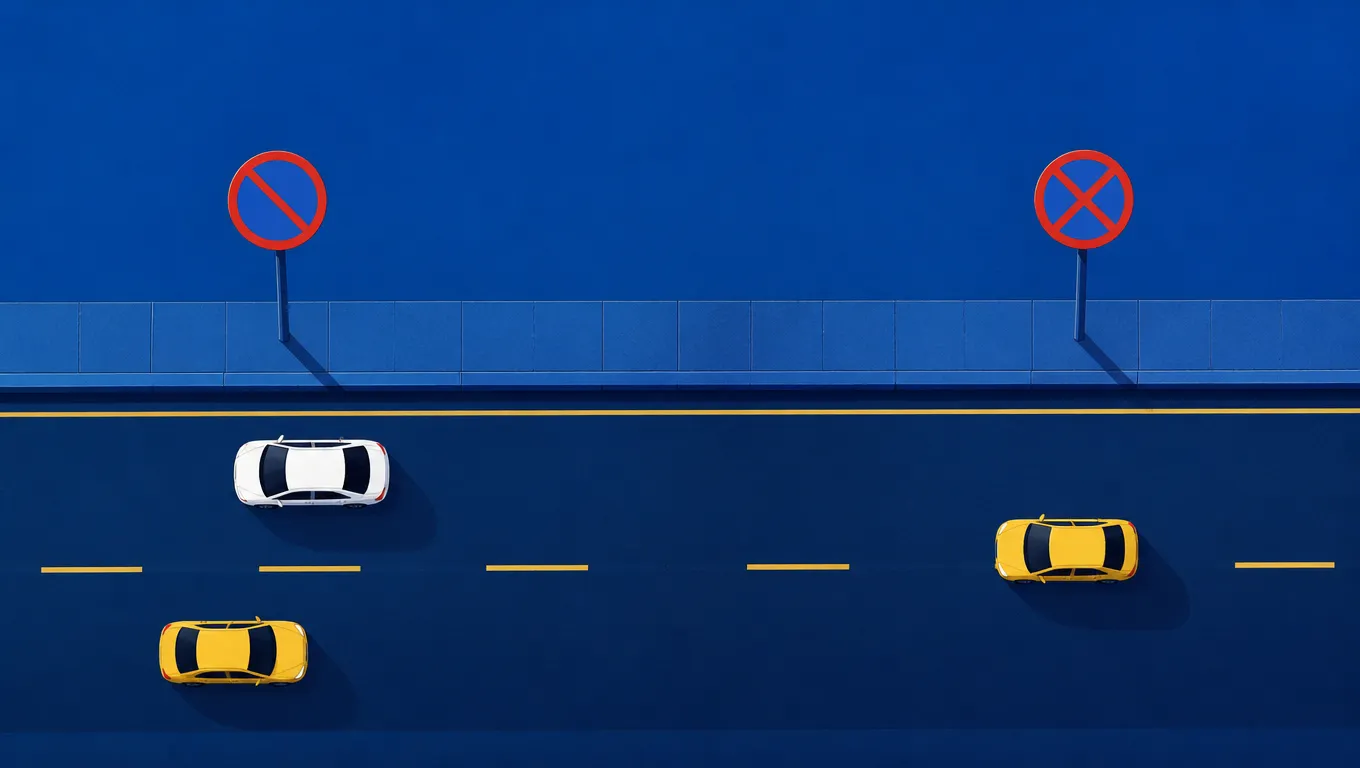
Both signs are blue discs with a red ring. With the red cross (absolutes Halteverbot) you may not stop on the carriageway at all. With a single red slash (eingeschränktes Halteverbot) you may stop for up to 3 minutes, or longer only to let people get in or out or to load and unload. Parking is forbidden under both.
The law text spells it Haltverbot. In everyday German almost everyone says Halteverbot. It is the same thing.
Stopping, parking and waiting are three different things
The two signs only make sense once you know these terms.
- Stopping (Halten) is a short, chosen break in your journey, for example to let someone out.
- Parking (Parken) begins as soon as you leave the vehicle or stop for longer than 3 minutes.
- Waiting at a red light or in a traffic jam is neither. Traffic forces you to stand, so no stopping ban is broken.
Sitting in the car does not help. After 3 minutes it is parking. A running engine or hazard lights change nothing either.
Absolutes Halteverbot: the red cross
The sign with the red cross forbids stopping on the carriageway. That means not for a passenger, not for a parcel and not for a few seconds. If you need to let someone out, drive on to a place where stopping is allowed.
Standing in a queue under this sign is fine, because that is waiting.
Eingeschränktes Halteverbot: one red slash
Most people call this the no-parking sign. It allows two things:
- A stop of up to 3 minutes for any reason, as long as you stay with the car.
- A longer stop to let people get in or out, or to load and unload. Loading must be done without delay.
Waiting 10 minutes in the car for a friend is not covered. That is parking.
| Red cross | One red slash | |
|---|---|---|
| German name | absolutes Halteverbot | eingeschränktes Halteverbot |
| Stop up to 3 minutes | No | Yes |
| Let someone in or out | No | Yes |
| Load and unload | No | Yes, without delay |
| Park | No | No |
| Wait in a traffic queue | Yes | Yes |
Where the ban starts and ends
Both signs apply only on the side of the road where they stand. The ban runs until the next junction on that side, unless a sign ends or changes it before.
White arrows inside the sign show the stretch:
- Arrow pointing towards the road: the ban starts here.
- Arrow pointing away from the road: the ban ends here.
- Arrows in both directions: you are in the middle of the stretch.
A plate under the sign can limit the ban to certain days or hours. Read sign and plate together. Other plates exempt residents with a parking permit, or extend the ban to the hard strip beside the road.
There is also a zone version. A white rectangular sign with the slash sign and the word ZONE applies the restricted ban to all public road space in the area, until the end-of-zone sign.
Temporary signs for house moves and roadworks
Mobile no-stopping signs for a house move, a film shoot or roadworks are binding like fixed ones. A temporary ban also overrides signs that normally allow parking at that spot. Read the dates and times on the plate before you leave your car there for several days.
What a violation costs
As of November 2026 the federal fine catalogue lists 20 euros for stopping where it is not allowed and 25 euros for parking there. The amount rises if you hinder others.
Not every stopping ban has a sign. Narrow places, sharp bends and the 5 m before a zebra crossing are closed without one. See where you may not park in Germany and the rules on lowered kerbs. For reading the sign families in general, see German road signs explained.
Common mistakes
- “The cross and the slash mean the same.” The cross forbids every stop. The slash leaves you 3 minutes and loading.
- “With hazard lights on I may stop for a moment.” Hazard lights warn of danger. They do not cancel a ban.
- “I stay in the car, so I am not parking.” After 3 minutes you are parking, with or without a driver at the wheel.
- “The sign covers both sides of the street.” It covers only the side where it stands.
- “The ban ends where the parked cars start.” It ends at the next junction on that side, or at a sign that ends it.
How to remember it
A cross crosses out everything. One slash leaves you one short stop of 3 minutes.
For the arrows, picture the sign as a gate: the arrow pointing to the road opens the ban, the arrow pointing away from the road closes it.