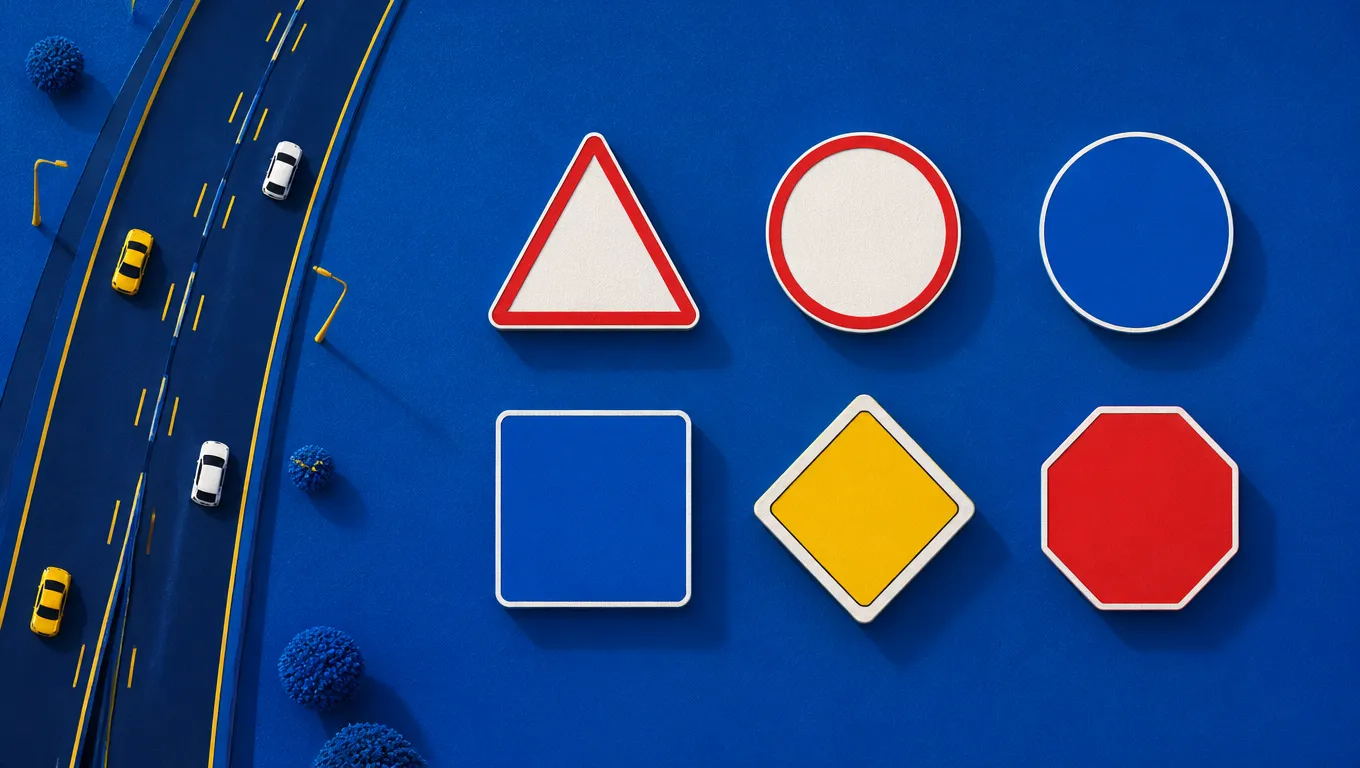
German road signs (Verkehrsschilder) can be sorted by shape and colour before you read what is on them. A triangle warns, a red ring forbids or limits, a blue disc gives an order, and a square or rectangle informs. If you know these four families, most signs explain themselves.
The four families of Verkehrsschilder
The road traffic regulations (StVO) name three legal groups: danger signs (Gefahrzeichen), regulatory signs (Vorschriftzeichen) and guidance signs (Richtzeichen). For learning, it is easier to split the regulatory group in two, which gives four families.
| Shape and colour | Meaning | Examples |
|---|---|---|
| White triangle, red border, tip up | Warning: a danger is ahead | Bend, road works, children, wild animals |
| White disc with a red ring | Ban or limit | Speed limit, no overtaking, no vehicles |
| Blue disc with a white symbol | Order | Mandatory direction, cycle path, roundabout |
| Square or rectangle, often blue | Information | Parking, motorway, one-way street |
Decide the family first. Then read the picture or the number.
Signs normally stand on the right and apply to your direction of travel. If a sign applies to one lane only, it usually hangs above that lane.
Warning signs ask you to act at the sign
A warning sign does not forbid anything. It tells you about a danger you may not see in time. You react at the sign: ease off, look further ahead and be ready to brake.
In towns the sign stands shortly before the danger. Outside towns it normally stands 150 to 250 m before it.
Two warning signs deserve extra care. The children sign stands near schools and playgrounds, and you slow down even when you see nobody. The leaping deer warns of wild animals, mostly at dusk, at night and at dawn. Where one animal crosses, more often follow.
Red ring forbids, blue disc orders
A number in a red ring is a maximum speed. It is a ceiling, not a target. In fog, rain or heavy traffic you drive slower. The same number on a blue disc is a minimum speed.
German ban signs usually have no red slash. The red ring alone means forbidden. A car inside a red ring does not mark a road for cars. It bans them. An empty red ring bans vehicles of all kinds in both directions.
The red disc with a white bar means no entry from your side. Traffic can still come out towards you.
A blue disc is never a suggestion. An arrow on it fixes your direction. A bicycle, a walking person or a bus on it reserves that path or lane for them, and cars keep off. Compare the colours: a bicycle on blue reserves the path for cyclists, a bicycle in a red ring bans them.
The parking signs mix both colours. They are blue discs with a red ring and one or two red bars. See absolute and restricted no-stopping signs.
Square signs inform, and some start special rules
Square and rectangular signs tell you something useful: here you may park, here a town begins. Some of them also switch on a set of rules.
- The yellow town sign (Ortstafel) starts the in-town rules, such as the general 50 km/h limit. More on this in speed limits in Germany.
- The motorway sign starts the motorway rules: no stopping, no turning round, no reversing.
- The one-way street sign (Einbahnstraße) is a blue rectangle with a white arrow. It is binding.
- A zone sign, a white rectangle with the word ZONE, covers every street in the area until the end-of-zone sign. It is not repeated after each junction.
A few signs have a shape of their own, so you know them even from behind: the octagonal stop sign and the give-way triangle standing on its tip. Both are covered in Vorfahrt gewähren and the stop sign.
The small plate under a sign changes its meaning
Under many signs hangs a small white plate with a black border. It is a supplementary plate (Zusatzzeichen). It belongs to the sign directly above it and makes that sign narrower or wider.
| Plate | Meaning |
|---|---|
| bei Nässe | Only when the road is wet |
| 7-19 h | Only between 7:00 and 19:00 |
| Lorry picture | Only for lorries |
| Bicycle and frei | Cyclists are exempt |
| Distance in metres | How far ahead, or for how long |
Example: a sign shows a maximum of 80 km/h. The plate below says bei Nässe. On a dry road the 80 does not apply to you. As soon as the surface is wet, it does.
Which signal wins when two disagree
Signs are one layer in a fixed order:
- A police officer directing traffic.
- Traffic lights.
- Signs and road markings.
- The general rules, such as right before left.
The higher layer always wins. When the lights are switched off, the signs decide again. Road markings count as signs too. Yellow markings are temporary and replace the white ones.
Common mistakes
- “A blue square is an order.” It only informs. Parking allowed does not mean you must park. Only round blue signs order.
- “A car in a red ring marks a road for cars.” The red ring forbids what it shows.
- “Frei on a plate means the road is free for everyone.” It frees only the group shown on the plate.
- “A speed limit ends at the next junction.” A limit shown by a sign runs until a sign ends it. If it stands together with a warning sign, it also ends where that danger is clearly over.
- “I react when I see the danger.” A warning sign asks you to slow down at the sign, before the danger is visible.
How to remember it
Triangle: take care. Red ring: you may not. Blue disc: you must. Square: good to know.
For conflicts, think from the top down: officer, lights, signs, rules.