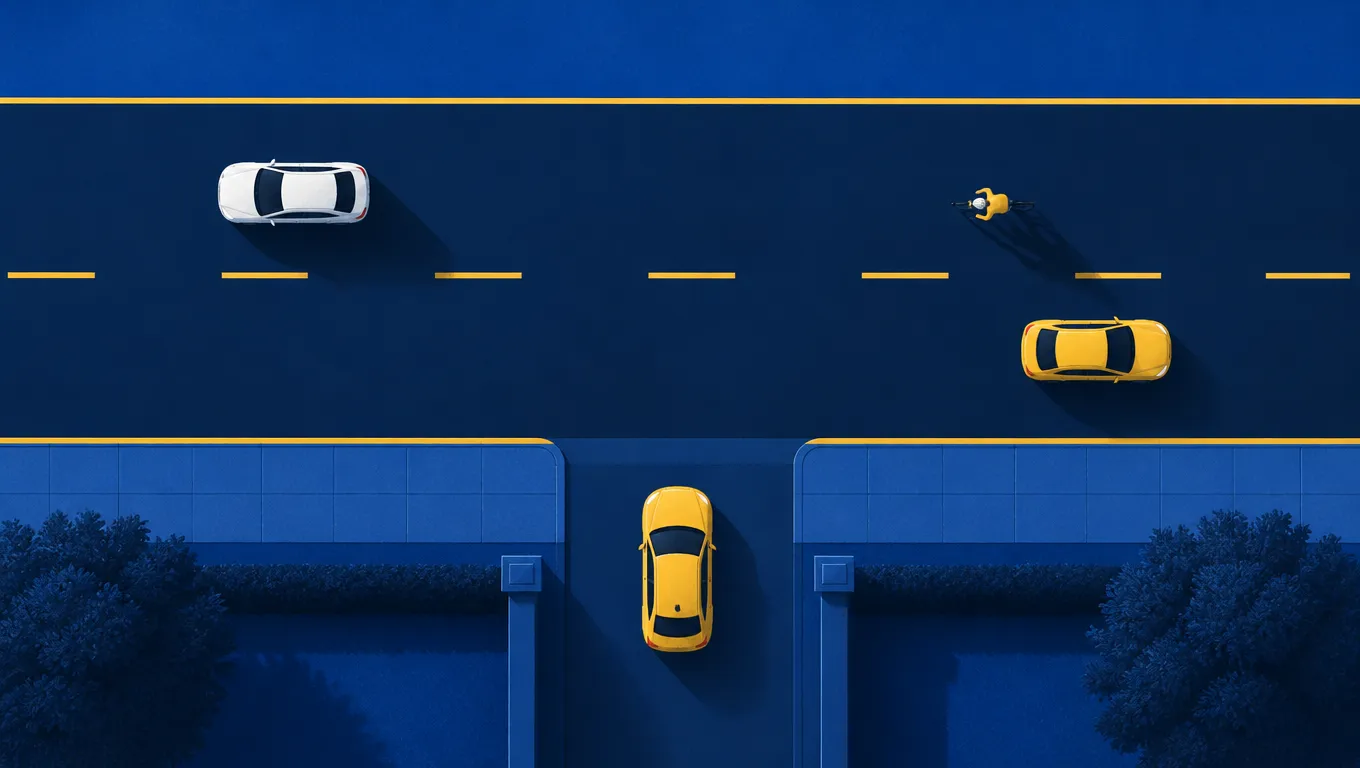
Abgesenkter Bordstein Vorfahrt (priority at a lowered kerb) is settled in one line: whoever drives onto a road across a lowered kerb has no priority. That driver waits for all traffic on the road, from both sides, and for pedestrians on the pavement. Right before left does not apply, even if the driver comes from the right.
What a lowered kerb is
A kerb (Bordstein) is the stone edge between the road and the pavement. Where a driveway or a small side road meets a bigger road, the kerb is often not interrupted. It continues across the mouth of the side road and is only lowered so that wheels can roll over it. The pavement runs straight through.
That is the difference from a normal junction. At a normal junction the kerb curves round the corner and the road surface of the side street joins the main road directly. At a lowered kerb you drive over the pavement to get out.
You find lowered kerbs at:
- driveways and exits from properties, garages and car parks
- small residential roads and access roads that join a larger street
- many exits from traffic-calmed zones
Abgesenkter Bordstein Vorfahrt: what the law says
The rule sits in the section of the road traffic regulations on driving in and moving off. It names several cases together. Whoever drives onto the road from a property, from a pedestrian zone, from a traffic-calmed zone (verkehrsberuhigter Bereich) or across a lowered kerb must behave so that no danger to other road users is possible. The same duty applies when you move off from the edge of the road.
That is a strict standard. The law does not just say “give way”. It says danger to others must be ruled out. In practice:
- You wait for vehicles from the left and from the right.
- You wait for cyclists on the road and on the cycle path.
- You wait for pedestrians on the pavement you cross.
- You signal your intention in time, using the indicator.
- If you cannot see enough, you get someone to guide you out.
Where the situation is unclear, the authorities may put up a yield sign to make the duty to wait obvious. But the duty exists without any sign.
Why right before left does not help you
Right before left is a rule for junctions between roads of equal standing. A lowered kerb marks the side road as subordinate, in the same way a driveway is. So the picture can look like this:
You drive along a residential street with no signs. A small road joins from your right. At a normal junction you would have to let a car from that road go first. But the pavement and the kerb run across its mouth, and the kerb is lowered. The car coming out has to wait for you.
The same goes for the driver on the small road. Coming from the right gives them nothing. See rechts vor links for the full list of places where that rule does not apply.
How to behave on each side
If you cross the lowered kerb:
- Stop before the pavement. People walk there, and children on scooters and bikes use it too.
- Let pedestrians pass, then creep forward to the edge of the road.
- Look both ways. Parked cars often block the view, so move forward slowly, a little at a time.
- Signal, and pull out only when nobody has to brake or swerve for you.
If you are on the through road:
You have priority, but do not count on it blindly. A lowered kerb is hard to see from the main road, and a driver from the side may believe that right before left applies. Watch the front wheels of a car waiting there. If it rolls, lift off and be ready to brake. The law expects you to give up priority when that prevents an accident.
Parking at a lowered kerb
A second rule is tied to the same piece of stone. Parking in front of a lowered kerb (Bordsteinabsenkung) is forbidden. The law gives no distance in metres for this. The lowered stretch itself has to stay free. Parking in front of property entrances and exits is forbidden as well. More in parking rules in Germany.
What it costs
As of November 2026, the catalogue of fines lists 30 euros for endangering another road user when driving in or moving off, and 35 euros if damage results.
Common mistakes
- “I come from the right, so I go first.” Not across a lowered kerb. You wait for everyone.
- “It is a proper road with a street name, so it is a normal junction.” The kerb decides, not the name. If the kerb runs through and is lowered, the side road waits.
- “I only have to watch the cars.” You cross a pavement first. Pedestrians and cyclists there go before you.
- “I am on the main road, nothing can happen.” The other driver may not have noticed the kerb. Stay ready to brake.
- “The kerb is low here, a handy place to park.” Parking in front of a lowered kerb is not allowed.
How to remember it
If your wheels bump over a kerb on the way out, you are last.
A second hook: treat a lowered kerb like a driveway. Nobody expects priority when leaving a garage.