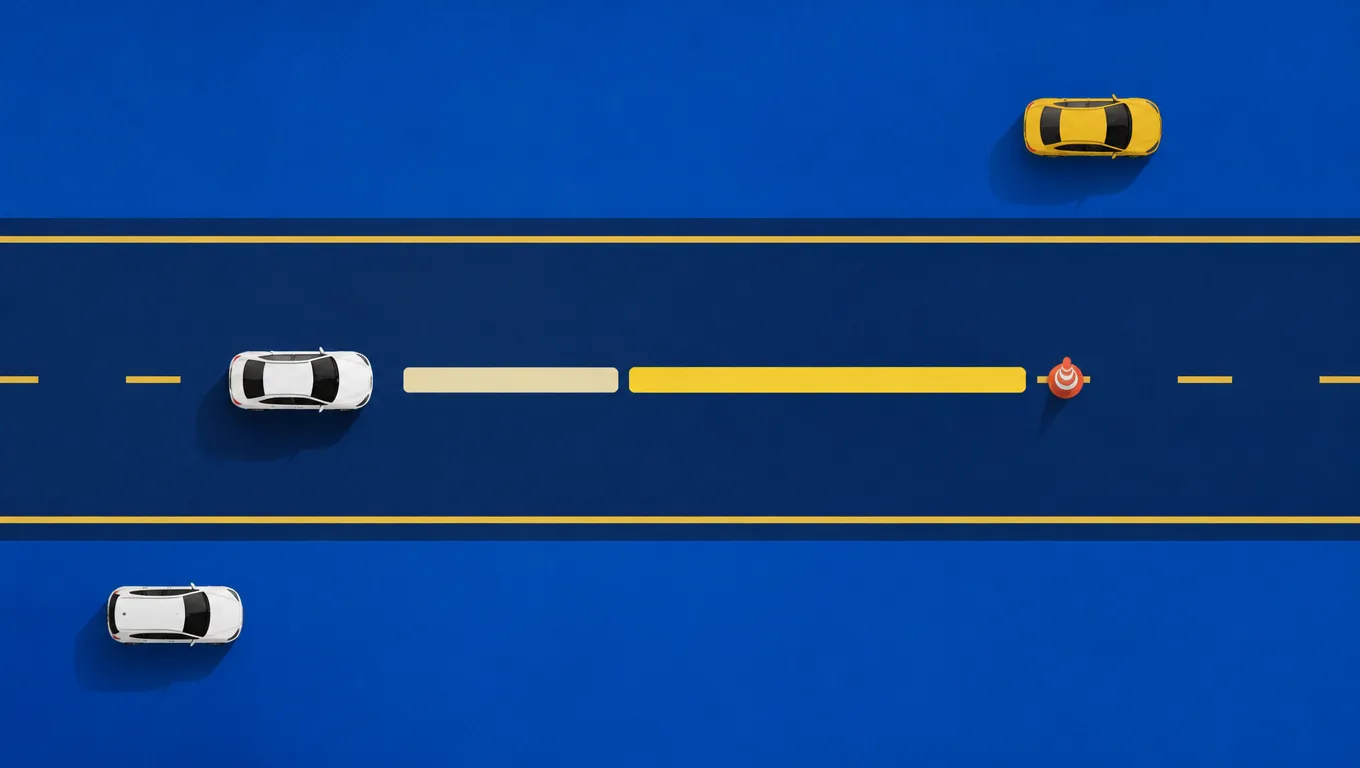
The Anhalteweg Formel is: stopping distance = reaction distance + braking distance. At 50 km/h with normal braking that is 15 m + 25 m = 40 m. With emergency braking it is 15 m + 12.5 m = 27.5 m.
The three parts
The stopping distance (Anhalteweg) is the whole way from the moment you see a danger to the moment the car stands still. It has two parts, and each has its own rule of thumb.
| Part | German term | Rule of thumb, in metres |
|---|---|---|
| Reaction distance | Reaktionsweg | speed ÷ 10 × 3 |
| Braking distance, normal | Bremsweg | speed ÷ 10 × speed ÷ 10 |
| Braking distance, emergency | Gefahrbremsung | half of the normal braking distance |
| Stopping distance | Anhalteweg | reaction distance + braking distance |
The speed is always in km/h. The separate posts on the reaction distance and the braking distance explain where each rule comes from. All of them are rules of thumb for a dry road and a car in good order.
Worked examples: 50 and 100 km/h
First 50 km/h.
- Reaction distance: 50 ÷ 10 = 5, and 5 × 3 = 15 m.
- Braking distance, normal: 5 × 5 = 25 m.
- Stopping distance: 15 m + 25 m = 40 m.
With emergency braking only step 2 changes. Half of 25 m is 12.5 m. The stopping distance is then 15 m + 12.5 m = 27.5 m.
Note what is not halved: the reaction distance. Hard braking does not make you react faster.
Now 100 km/h.
- Reaction distance: 100 ÷ 10 = 10, and 10 × 3 = 30 m.
- Braking distance, normal: 10 × 10 = 100 m.
- Stopping distance: 30 m + 100 m = 130 m.
With emergency braking: 30 m + 50 m = 80 m.
Anhalteweg Formel results at a glance
| Speed | Reaction | Braking (normal) | Stopping (normal) | Stopping (emergency) |
|---|---|---|---|---|
| 30 km/h | 9 m | 9 m | 18 m | 13.5 m |
| 50 km/h | 15 m | 25 m | 40 m | 27.5 m |
| 80 km/h | 24 m | 64 m | 88 m | 56 m |
| 100 km/h | 30 m | 100 m | 130 m | 80 m |
| 130 km/h | 39 m | 169 m | 208 m | 123.5 m |
Compare 50 and 100 km/h. The speed doubles. The reaction distance doubles too, from 15 m to 30 m. The braking distance becomes four times as long, from 25 m to 100 m. In total the stopping distance grows from 40 m to 130 m, which is more than three times as far.
What the numbers mean in a 30 zone
A child steps onto the road 20 m ahead of you.
At 30 km/h your stopping distance with normal braking is 18 m. You stop in time, with 2 m to spare.
At 50 km/h your stopping distance is 40 m. You do not stop in time. After 15 m you have only just started to brake, and with normal braking the car needs another 25 m.
The difference of 20 km/h decides whether the car is standing or still moving when it reaches the child. This is the point the formulas are meant to teach.
How to handle a calculation question
Questions on this topic follow a fixed pattern. A calm routine helps:
- Read which distance is asked for: reaction, braking or stopping.
- Read whether it says normal braking or emergency braking.
- Work out the reaction distance.
- Work out the braking distance. Halve it if it is emergency braking.
- Add the two only if the stopping distance is asked for.
Write the steps down. Most errors are not arithmetic errors. They come from answering a different question than the one that was asked.
When the real distance is longer
The formulas give a best case. The real stopping distance grows when:
- the road is wet, snowy or icy
- tyres or brakes are worn
- the car is heavily loaded or the road runs downhill
- you are tired, distracted or have taken alcohol or medicine, because your reaction time grows
For that reason the rule on speed is not a number. You must always be able to stop within the distance you can see. On roads so narrow that oncoming traffic could be endangered, you must be able to stop within half of that distance. The same thinking sets the gap to the vehicle ahead.
Common mistakes
- Giving the braking distance when the stopping distance is asked. The stopping distance always includes the reaction distance.
- Halving the whole stopping distance for emergency braking. Only the braking part is halved. 50 km/h gives 27.5 m, not 20 m.
- Mixing up the two formulas. “Times 3” is reaction. “Times itself” is braking.
- Thinking twice the speed means twice the stopping distance. From 50 to 100 km/h it grows from 40 m to 130 m.
- Treating the result as exact. These are rules of thumb for a dry road. On a wet road you need much more.
How to remember it
“React, brake, add.” Three words, three steps, always in this order.
As an anchor value, learn 50 km/h by heart: 15 + 25 = 40. If you can rebuild that line, you can rebuild every other speed from the same pattern.