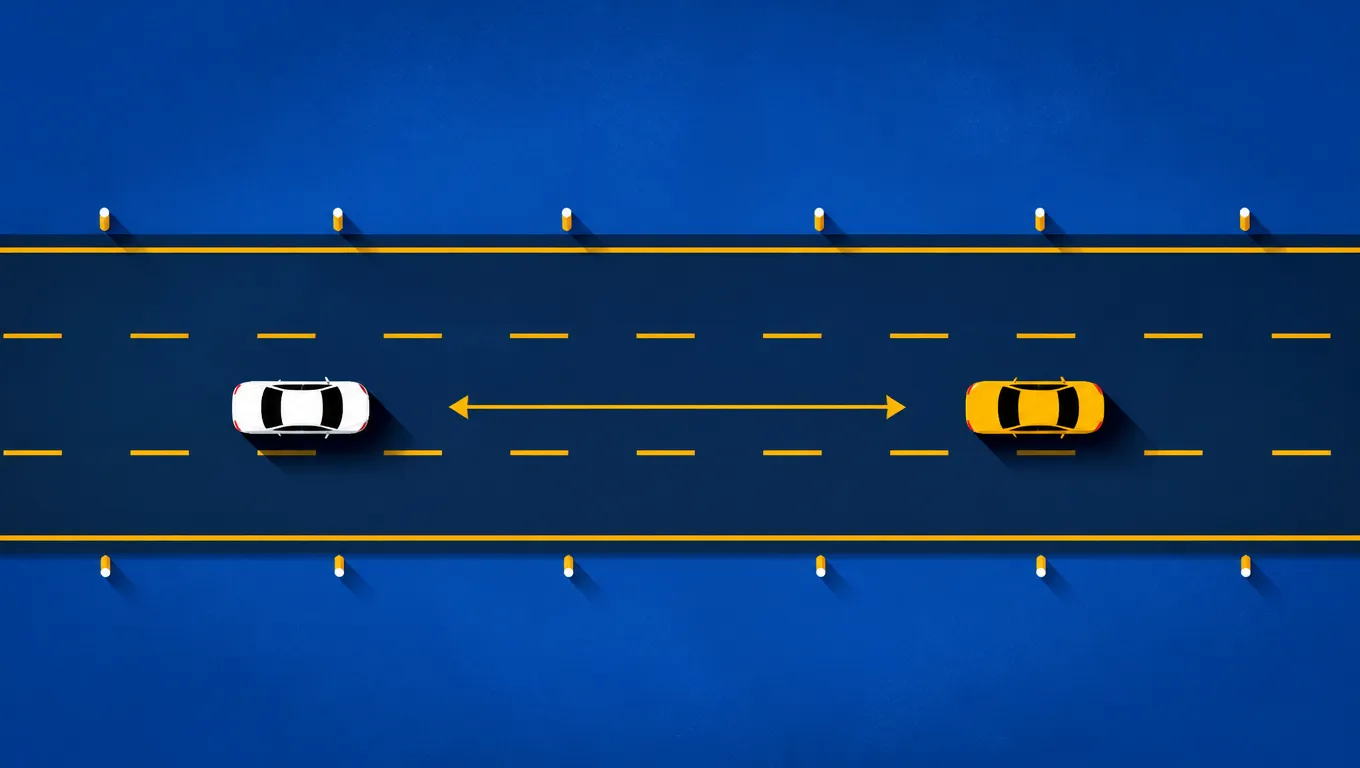
The Sicherheitsabstand is the gap you keep to the vehicle ahead. German law gives no figure in metres for cars. It demands a gap large enough that you can stop behind the vehicle ahead even if it brakes suddenly. Outside town the rule of thumb is half the speedometer value in metres, or two seconds.
What the law says about Sicherheitsabstand
The rule is in § 4 of the road traffic regulations (Straßenverkehrs-Ordnung, StVO). It has two sides:
- The driver behind must normally keep enough distance to stop safely if the vehicle ahead brakes suddenly.
- The driver ahead must not brake hard without a compelling reason.
For cars, that is all. The well-known numbers are rules of thumb that turn this duty into something you can check from the driver’s seat. Only one group has a fixed figure in the law: lorries over 3.5 t and buses must keep at least 50 m on the motorway when they drive faster than 50 km/h.
Half the speedometer: the rule outside town
The best-known rule of thumb is “half the speedometer” (halber Tacho). You take your speed in km/h, halve it, and read the result as metres.
| Speed | Minimum gap by rule of thumb |
|---|---|
| 80 km/h | 40 m |
| 100 km/h | 50 m |
| 130 km/h | 65 m |
The marker posts (Leitpfosten) beside country roads and motorways normally stand 50 m apart. At 100 km/h your gap should be at least one full space between two posts.
The two-second rule
The two-second rule gives about the same gap and works at any speed, without estimating metres.
- Pick a fixed point ahead, such as a marker post, a sign or a bridge.
- When the vehicle ahead passes it, count “twenty-one, twenty-two”.
- If you reach the point before you have finished counting, you are too close.
Check the gap again after every change of speed. If someone cuts into your gap, ease off and build it up again.
The gap in town
In town, speeds are lower and traffic is dense. A common guide at 50 km/h is about 15 m. That is roughly three car lengths, or one second. This is a teaching value, not a figure from the law. The duty stays the same: you must be able to stop if the vehicle ahead brakes suddenly.
When you need more than the minimum
Half the speedometer and two seconds are minimum values for good conditions. You need clearly more:
- on a wet, snowy or icy road, because the stopping distance grows
- in fog or darkness
- when you are tired
- behind motorcycles, and behind large vehicles that block your view
In fog, do not hang on to the tail lights ahead. Keep a gap you can stop in.
If the driver behind you tailgates, do not speed up and do not brake to teach a lesson. Increase your own gap to the front. Then you can brake more gently, and the driver behind has more time.
Fines for too small a gap
As of November 2026, ADAC lists these consequences for cars. The fractions refer to half the speedometer value. “Less than 5/10” means less than half of the half-speedometer gap, so less than 25 m at 100 km/h.
| Speed | Gap | Fine | Points | Driving ban |
|---|---|---|---|---|
| Under 80 km/h | too small | 25 euro (30 with danger, 35 with damage) | none | none |
| Over 80 km/h | less than 5/10 | 75 euro | 1 | none |
| Over 100 km/h | less than 3/10 | 160 euro | 2 | 1 month |
| Over 130 km/h | less than 1/10 | 400 euro | 2 | 3 months |
The table shows only a few steps of the scale. In between, the fine rises with every tenth. Fees are added to the fine. How the points add up is explained in the post on points in Flensburg.
Two more consequences are worth knowing. Driving very close for a longer stretch to push someone, often with flashing headlights, can be punished as coercion (Nötigung), which is a crime and not a simple fine. And for new drivers, ADAC lists too small a gap among the serious offences in the Probezeit.
Common mistakes
- “The law says half the speedometer.” The law demands a gap you can stop in. Half the speedometer is a rule of thumb for good conditions outside town.
- “Our cars brake equally well, so a small gap is fine.” Your reaction time alone needs the room. While you react, your car travels on at full speed and the car ahead is already slowing.
- “My car has distance control and emergency braking.” These systems rely on sensors that rain, fog, snow, low sun or dirt can blind. You remain responsible for the gap.
- “Closing up tells the slow driver to move over.” It is dangerous, it can cost points and a driving ban, and it can be coercion.
- “In fog I follow the tail lights so I do not lose the road.” Then you cannot stop when they do. Keep your own safe gap.
How to remember it
“Half the speedo, or twenty-one, twenty-two.” One rule for metres, one for seconds, and both give about the same gap.
On the road, use the posts: at 100 km/h there should be one full post gap between you and the car ahead.